Leica owners were immediately excited with the first announcements of a full-frame, small, 36mp, mirrorless camera from Sony with the ability of accepting Leica M lenses. It sounded a bit like a Leica aficionado's holy grail: a high resolution, full frame body with a higher resolution than a Leica M, and costing only a third the price of the Leica M 240 - sounded like a perfect solution for a second, high quality body.
Sony brought the Sony A7R into the world with only two Zeiss prime lenses available for it plus one A7 Sony kit zoom of dubious quality - a very limiting series to say the least. The other Zeiss lenses in the series intended for this camera only begin to become available months from when the camera came out. You can adapt other Sony lenses to the camera, but this is a stop gap measure until the real thing comes along, and most of us do not have the other Sony lenses anyway.
 |
| A Sony A7r camera with 36.4MP sensor and mounted with a Leitz 35mm Summilux lens. Around it are some of the lenses used for testing in this blog post, including a 21mm Elmarit, 90mm Elmarit, 28mm Summicron, 50mm Summilux, 135mm APO-Telyt-M, and two Voigtlander super wide lenses, the 12mm (shown above) and 15mm. |
You can adapt Leica M lenses, if you have them, using a Leica M to Sony E mount adapter. At $2300 the A7r costs substantially less than a $6950 Leica M 240 camera body, and with 36.4MP sensor thrown in as an added bonus, it has the potential of serving as a second body to a Leica system, or of replacing the expensive Leica all together. The real question we all had is how well the Leica M lenses will perform on the A7r. The reason for concern is that the Leica M camera firmware coupled with sensor design is configured to work with and correct the known aberrations in its own lenses, whereas the Sony A7r is not. This is not such a big concern in medium to long focal lengths, but can become serious with wide angles. The sensor in the A7r also has micro lenses on it to compensate for the short throw of rangefinder lenses, particularly wide and super wide angle lenses. This addition may help somewhat with the use of shorter Leica lenses. We shall see later it this helps.
There are a number of M to E adapters available. I tried two and had problems with one of them. Until the A7 series came along, the E-mount was used on smaller APS-C sensor cameras that did not require an opening as large as a full frame camera. One adapter I used, a Voigtlander, had a black ring inside of it that caused vignetting with the M lenses. I ended up using a Metabones M-E adapter, which worked fine with the full range of M lenses I tried.
 |
| The real question mark of lens adaptability is with the wide angles, such as the 28mm Summicron mounted above and the 21mm f/2.8 Elmarit-M next to it. |
The A7r has a 36.4MP sensor, and no covering anti-
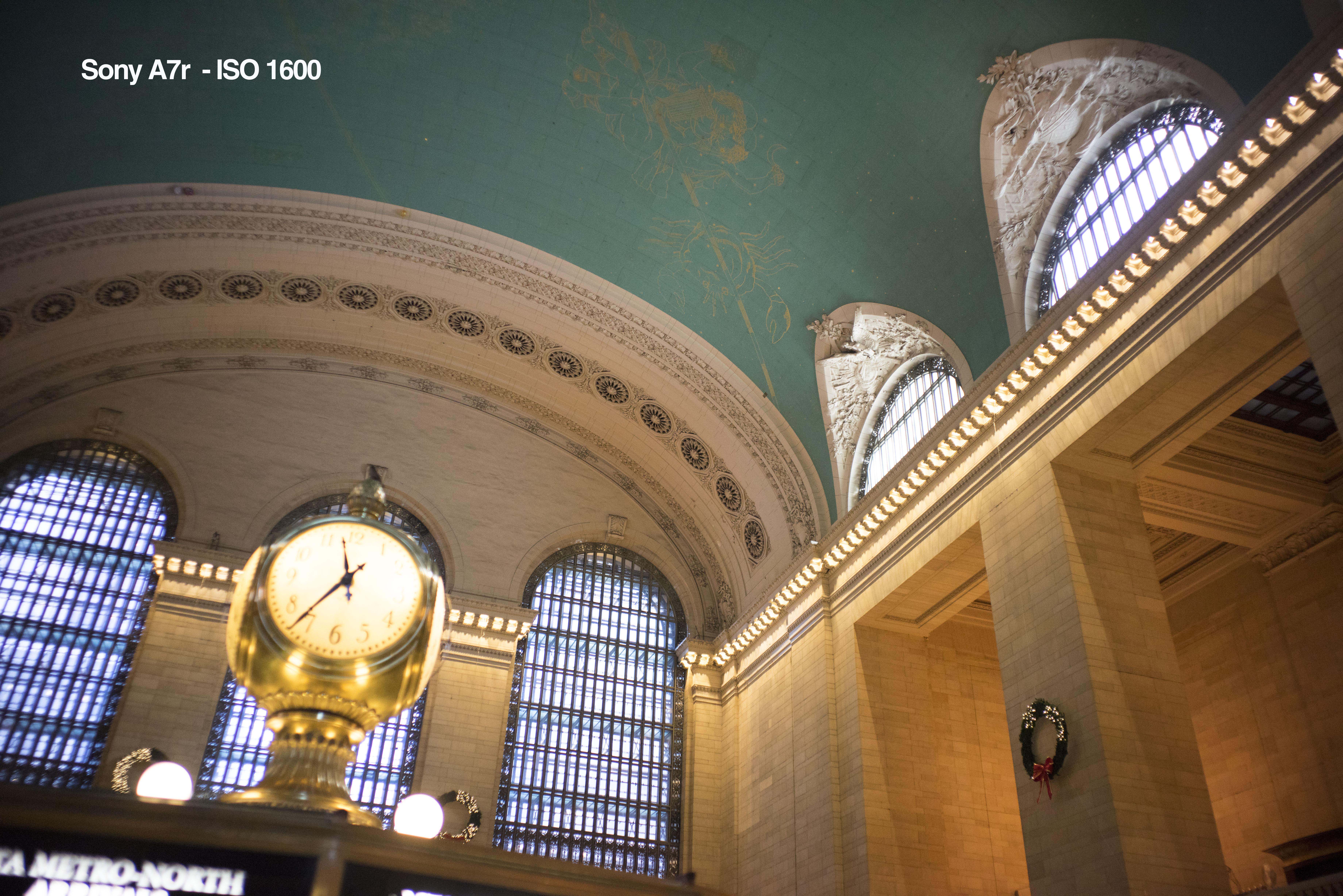
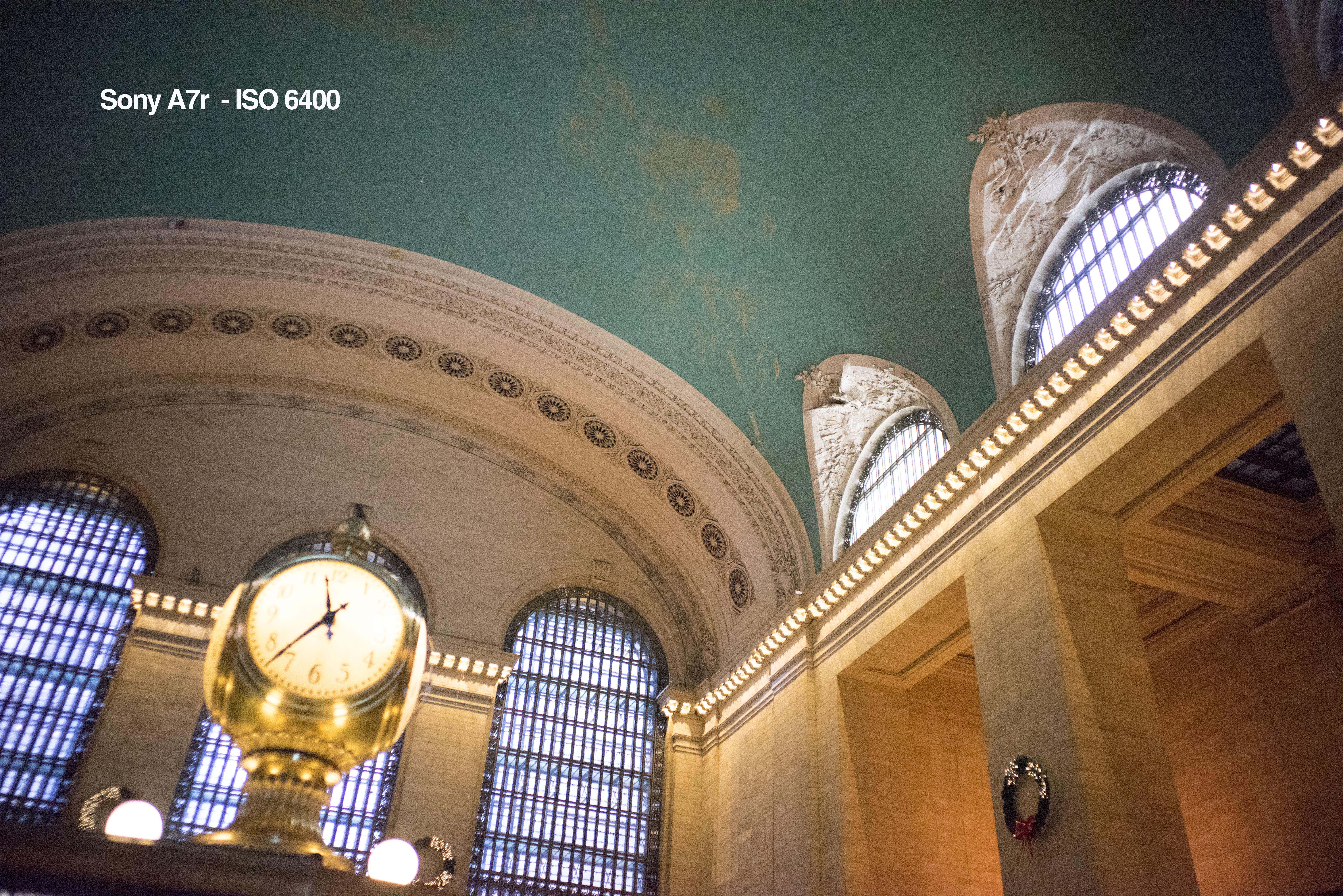
aliasing filter. It is the same sensor used in the Nikon D800E, and, as you would expect, its performance is close to par with that camera. That may be all that is necessary to say about the image quality from the A7r. The performance of the D800 camera is about as good as things get with current digital technology. So not much is left to add about the image quality of the A7r. It produces, as you would expect, top notch resolution and very good noise control at high ISO levels, although a camera of this type is not typically intended for shooting situations where noise would be an issue. A high resolution camera is generally used for landscape, fashion, and still life advertising photography, and where very large print output is necessary. These are situations that generally require tripods or stobes, and don't require high speed captures. For hand-held, low-light, or fast changing subjects, smaller resolution cameras are a better choice. Nonetheless, I did take an ISO test series of images that can be downloaded below.
 |
| This series of interiors of Grand Central Station was taken with the Leica 28mm Summicron lens. No post-processing was performed on the images. You can readily see the vignetting and color fringing. Download high res version of the various upper ISO samples with the links below. These files came from a 36MP camera so they are quite large. |
While testing the A7r with Leica lenses I had a Leica M 240 with me also and did some side-by-side comparative shots. For the sample below I used the same 50mm Summicron lens on both cameras.
 |
| One of these photos of the Chrysler Building was taken with the A7r, the other with the Leica M 240. You can download a high res version of the comparative set by CLICKING HERE. They are full res crops of the originals. The photos are not labeled. The results are given at the very end of this blog post, but first see if you can tell the difference on your own between the 36MP A7r and the 24MP Leica. |
Digital cameras with high megapixel sensors, like the A7r and
Nikon D800, also demand good shooting techniques. The whole purpose of using one of these cameras is to achieve optimal image results. To get the most from them means using a tripod almost all the time -- a lesson I learned the hard way shooting out west with a D800 and occasionally not using a tripod on a very sunny day. Even at high shutter speeds with vibration reduction lenses traces of motion blur softened the shots. The A7r is going to be even more demanding because of its light weight. It doesn't have the heftiness often needed to dampen vibration, even when on a tripod. Its small size won't suggest a heavy mount so it might be tempting to lighten your carry load with a lighter tripod. Not a good idea with this camera, if you want to get the most from it.
 |
| This picture of the Flatiron Building was done with the Leica 35mm Summilux lens, an excellent performer on the A7r. |
The image below shows uncorrected tests of each of the Leica lenses I used with wide open aperture on the A7r. Some very obvious correcting is going to have to be done in post processing to fix the vignette and chromatic aberrations. And, yes, the 15mm Voigtlander, as well as the 12mm, really are as bad as they look. Then again their performance on the Leica M 240 isn't much better. These lenses need a program like
CornerFix to correct their exposure, severe vignetting, and color distortions.
The chart shows that the middle and long focal length lenses of 35mm and longer need only minimal correction. It is when you hit 28mm and wider that the problems begin. This does not mean that exceptional images are not forthcoming from the A7r with Leica lenses. It does mean that some post-processing will be necessary to massage the images. Longer lenses like the 90mm (not shown) and 135mm need practically no corrections.
Color fringing was evident in pretty much all shots I did with the A7r and Leica lenses, but less so with the longer focal lengths.
One thing I noticed immediately about the A7r shutter is its noisy shutter, especially when compared to a Leica or Fuji X camera. You are not going to be doing any surreptitious shooting with the A7r in quiet environments. It has a definite double-clicking sound that is sharp and noticeable. The standard A7 has a different, more muffled sounding shutter with a single click that is more like what you would expect.
 |
| One of the best performing Leica lenses on the A7r was the Leica 135mm f/3.4 APO-Telyt-M used for the shot above. |
Focus peaking, especially when coupled with image magnification, has become a very helpful feature with manual focus lenses. On the A7r it can be set to varying intensities and color preferences. I have grown to really like the feature and found it very accurate on the Leica M 240 and Fuji X cameras. On the A7r I found the peaking to be too deep to always be accurate, even after making various adjustments to the intensity setting. The peaking would indicate focus, but sometimes it was tack sharp while the very next frame was off just a bit with the result that I lost a disproportionate number of sequential shots.
The A7r auto color interpretation was very good, although I did not have an opportunity to try it out in portraiture.
 |
| Two adapters were used to mount this Leica 80-200mm Elmarit --R zoom on the A7r -- a Leica R to Leica M adapter and then the Metabones M to Sony E adapter. This combo was used to take the two night shots below. |
Battery life on this camera is the worst I have ever witnessed. Sony does have an add-on battery accessory that will rectify this problem, but that is only negating what the camera set out to be, namely a very compact system. Having to add or carry spare batteries to make up for performance issues is a bit like sweeping dust under the carpet.
 |
| Two super-wide angle Voigtlander lenses with Leica M mount, the 12mm on the camera, and 15mm next to it. |
Frankly, these two super-wide Voigtlander lenses have terrible aberrations on digital cameras, but if you need a 12mm lens, you don't have many other options, and you're going to have to put up with beating the image into submission using considerable post-processing.
 |
| Taken with the Voigtlander 15mm f/4.5 lens on the A7r. Heavy vignetting and edge discoloration are a typical characteristic of this lens. As mentioned above, all of this can be corrected by running the image through CornerFix software. |
 |
| Same scene as above, but taken with the Leica 21mm f/2.8 Elmarit-M ASPH, one of my favorite super wide angle lenses. No post-processing was added to the two shots above. Results from the 21mm are very good, especially considering how wide it is. |
Conclusion:
If you are going to be using the A7r with Leica lenses, you should be prepared to compensate for the mis-match by having to perform some post-processing corrections.
This camera is probably going to be better served by its own Zeiss lenses when they become available. Until then, yes, we can adapt Leica M lenses to use on it, and from a point of view of size the fast aperture Leica lenses are more proportionate to the very small camera body. Sony had to make a serious compromise when it tried to have the smallest full frame interchangeable camera body and couple it with modern, auto-focus, stabilized lenses. The Zeiss lenses made for the camera are inherently heavy and bulky. To keep the size of the lenses to a level where they don't overpower the diminutive A7r body, they were given slow apertures. The two zooms, for instance, are f/4 lenses.
The A7r is a very specialized camera, and I am not sure its formula -- a full frame sensor in such a small camera body -- works. If I really need such high resolution, I feel like I have to pay my dues and go with the heavier, but more stable (i.e.vibration resistant) Nikon D800. If I want small and compact, I prefer an actual Leica M with its own lenses, or a Fuji X camera with its smaller lenses kit.
 |
| The setting sun lit the smoke from behind while the foreground buildings were in deep evening shadow, a difficult situation for any camera. the A7r pulled it off with excellent dynamic range and accurate color rendition and requiring only modest post-processing to balance out the light to dark areas. |
Unless you really, really need the 36.4MP the A7r delivers for making huge prints, the A7 may be a better choice for a small, full frame camera. At 24.5MP is is no slouch. It has a better shutter, faster burst speed (5fps vs 4fps for the A7r), and better auto-focus combining both phase-detection and contrast detection. It is also more forgiving when hand-held.
I am not even sure that full frame and small camera is a viable combination. APS-C sensors have come a long way and are a much better choice for a small camera. Right off the bat, the lenses can be smaller and lighter simply because they don't have to cover so large a sensor area. A camera like any of the top Fuji X models may be best-of-breed in this genre. Leica works because it comes with a full stable of top notch, tiny lenses -- manual focus, admittedly, but that is how to keep things really compact.
My main purpose in this experiment was to determine if the A7r could serve as a higher resolution substitute, or act as an extra body for a Leica M system. In the end I concluded that the results, while marginally better from the higher res A7r sensor, were not enough for me to use this camera instead of my Leica M 240. The Leica worked better and with considerably less post-processing hassle using its native lenses. This tended to negate any benefits the larger 36MP A7r sensor might have. If it's a less expensive spare body I want, I think I would opt for the features of the A7 over the A7r and save even more.
 |
| Pigeon in the snow, Leica 135mm APO-Telyt-M at f/3.4. |
In the end I don't think we will really know the full capability and usefulness of the A7r until it has a full complement of its own Zeiss lenses, and that is a long way off. In the meantime other camera manufactures will not be sitting still, which may be one reason why Sony released this camera prematurely relative to its lens system.
Results for the A7r/Leica M comparative test shots of the Chrysler Building: The Leica image is on the left, A7r on the right.
If you are planning on purchasing this camera, you can help support this site at no extra cost to you by purchasing from one of our affiliate sellers listed below and thanks for your support :
- Sony Alpha a7 Mirrorless Digital Camera can be ordered from: Amazon
- Sony Alpha a7R Mirrorless Digital Camera can be ordered from: Amazon
Free Shipping in US & Low Price On Amazon. For anyone looking for this model??





0 komentar:
Post a Comment