Tuesday

Fuji 10-24mm zoom lens - a hands on review

There is only one super-wide lens I know of that can remain perfectly sharp into the image corners with a full open aperture, and that is the Nikon 14-24mm f/2.8. A super wide angle zoom is a tough optical design to compute and gets extremely expensive when done right, if it can be done at all. With that in mind, Fuji was facing an uphill battle against the odds with its new XF 10-24mm f/4 zoom lens. Admittedly, it is a fixed f/4 and not f/2.8, but even so Fuji has been raising the bar with each new XF lens it produces. Question is: Can they do it again?

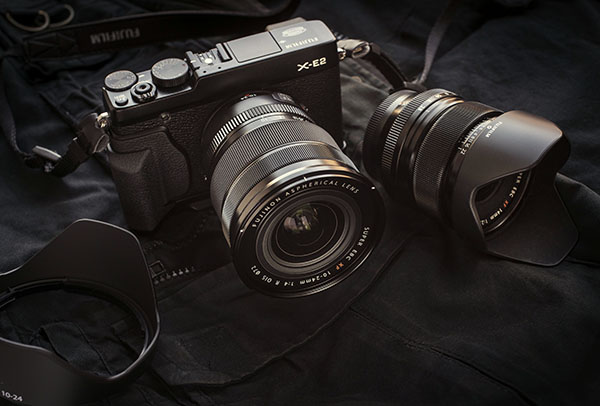
The Fuji XF 10-24mm f/4 zoom lens mounted on an X-E2 with an XF 14mm f/2.8 lens next to it.
As you will see from the sample images below, there is no rectilinear distortion with this lens.  This means you get a true focal length. Why? In the digital photography age rectilinear distortion, such as barrel and pincushion, is easily corrected in post processing, but in order to do so you need to crop the image. This may mean that the 14mm lens you bought becomes something like a 16mm lens due to the cropping necessary to correct the distortion. The Nikkon 14-24mm I mentioned earlier suffers from this, for instance.


The other thing I noticed with some of my first test shots was the absence of any vignetting -- very unusual, particularly for such a wide angle lens, and a zoom at that.

The 10-24mm is image stabilized, whereas the 14mm is not. Of course you are going to need at least one stop of image stabilization to make up for the difference between using f/4 and f/2.8 hand held in low light.
The 10-24mm zoom on the left compared  to the 14mm f/2.8 on the right. There is a big difference in size and weight. 
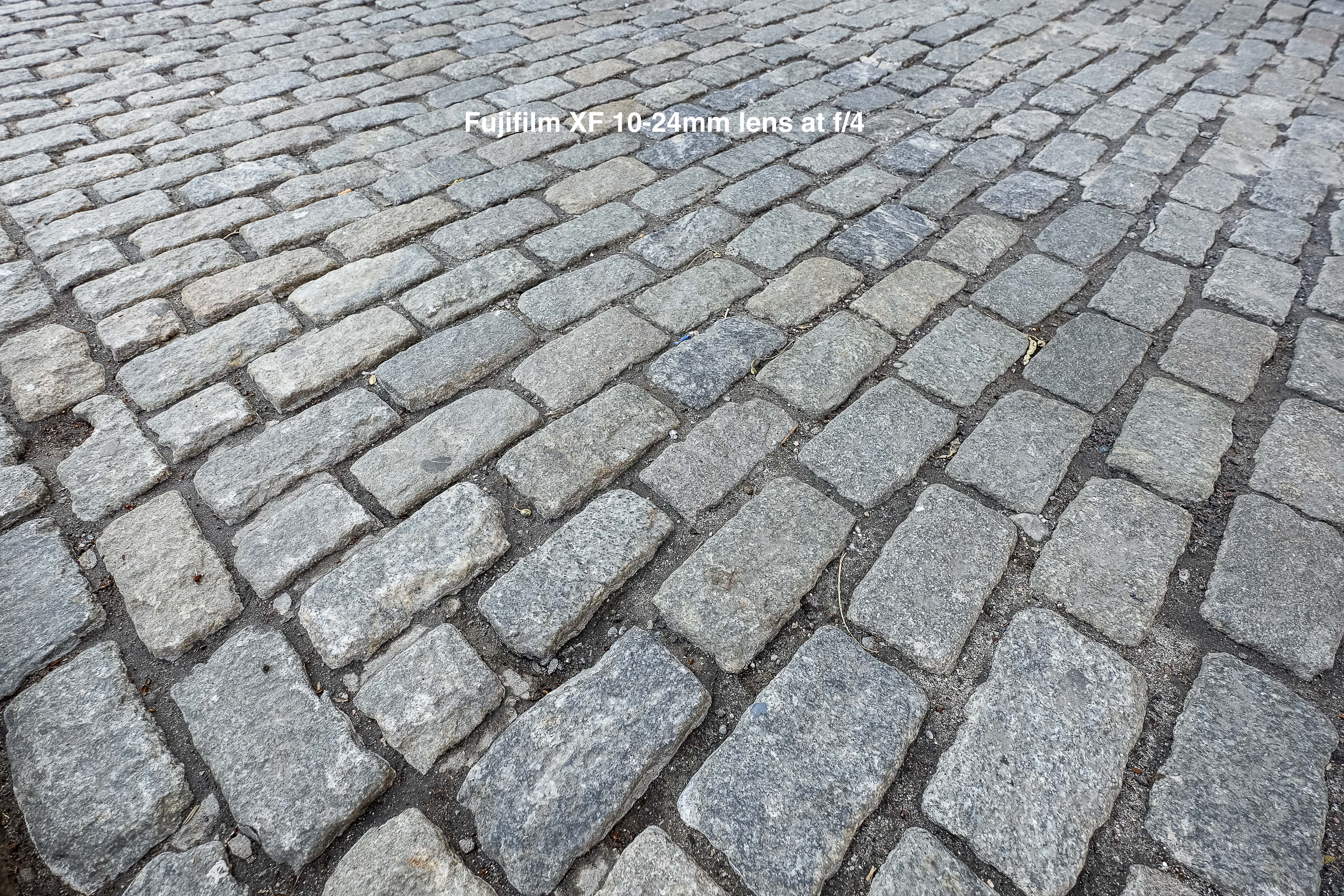
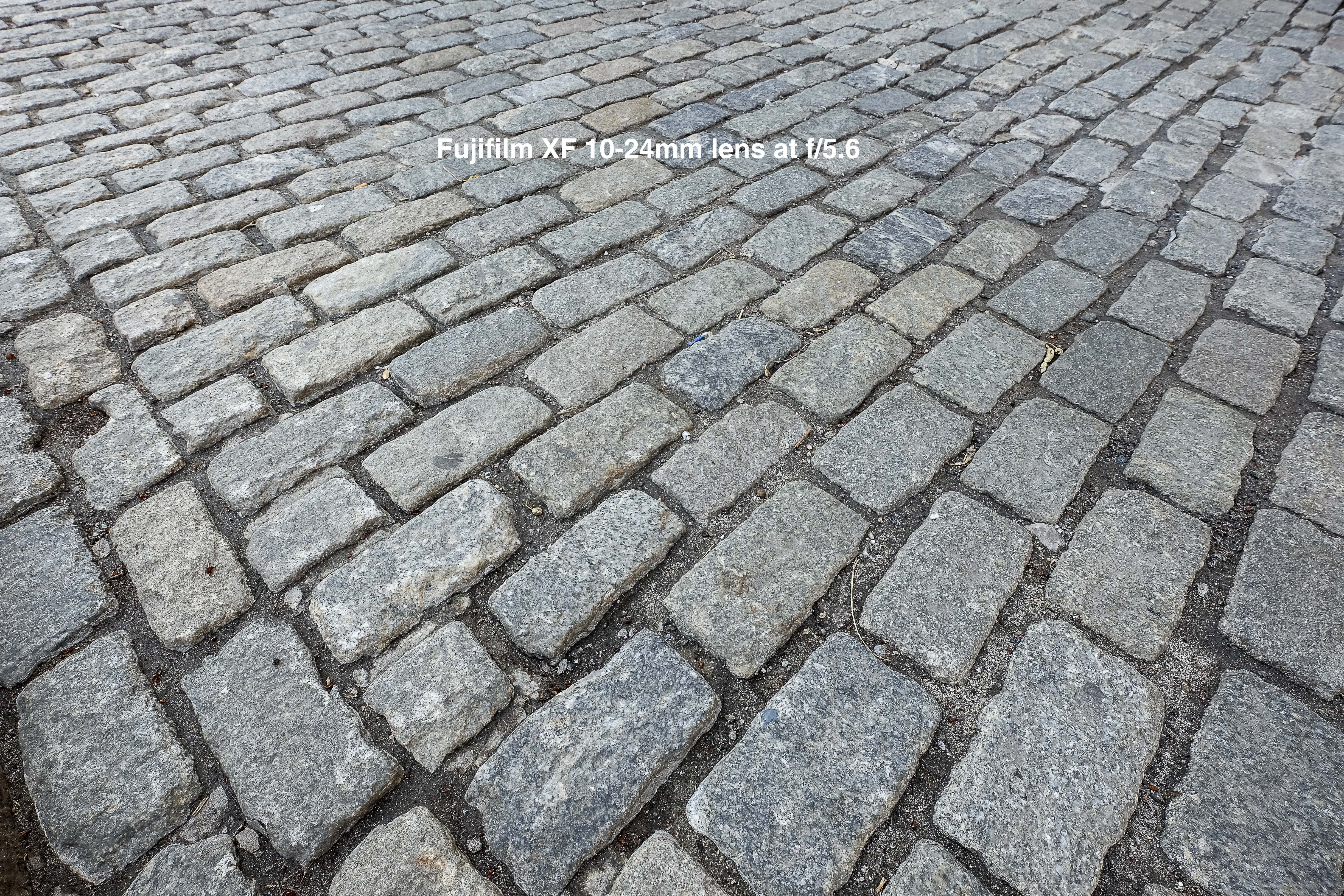
The test image below has no corrections applied. It was taken at 10mm and f/4 with the focus point placed in the center at the very bottom. You can download a high res version of the f/4 and f/5.6 files. At f/4 the lens shows only minimal softening at the bottom corners and is quite acceptable. As the lens zoomed in most of the corners sharpened also.

At f/5.6 there is literally a jump in sharpness that is astounding. I'm used to lenses getting a bit better as the aperture is stopped down one stop at a time. With the Fuji 10-24mm them move from f/4 to f/5.6 produces a jump in sharpness that is absolutely astounding and will probably have all of us putting tape on our apertures to fix them to either f/5.6 or f/8.

I did this test because it is a similar situation to shooting landscapes where the focus is on a sweeping foreground. Here the focus point was placed as low as possible in the center of the frame. Download the high res sample images below.

You can tell from the test photo above that there is virtually no vignetting or rectilinear distortion. Achromatic distorting was almost non-existent also.

How does the 10-24mm zoom compare to a fixed focal length wide angle lens like the Fuji 14mm? In tests I did with the two lenses where the 10-24mm zoom was set to 14mm and f/4 it appears to deliver the same image sharpness right into the corners, as the 14mm lens at f/4, which is to say it is very sharp.

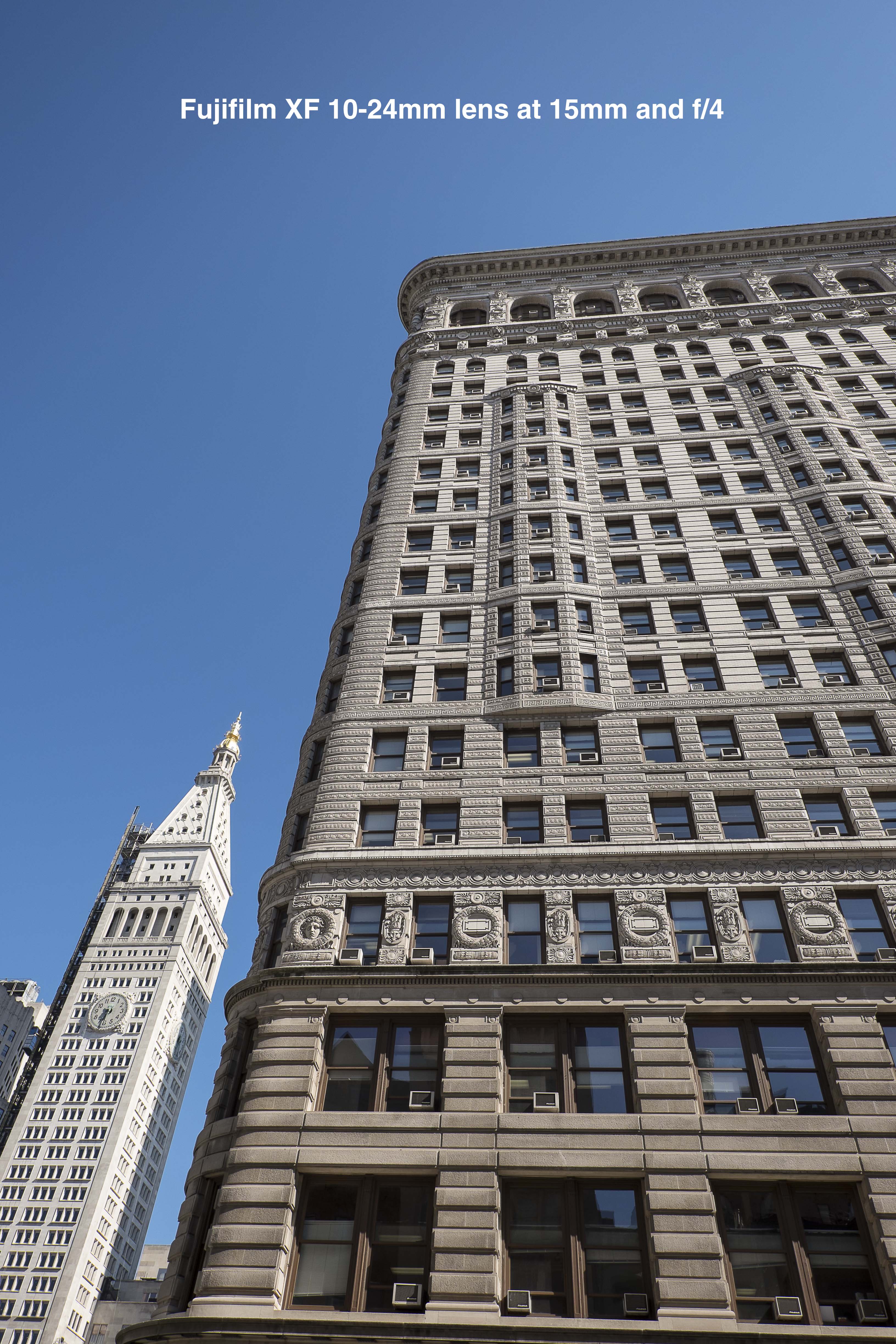
The Flatiron Building in NYC, one of my favorite test subjects for resolution because of the detailed mosaic work over the surface. Shot at f/4 at 15mm, it is tack sharp everywhere.  Click here to download a high res version.
Shot into the bright afternoon sun at 14mm and f/11 with the sun off towards the frame edge to cause maximum flaring.
An intentionally blurred 19mm tunnel shot hand held at 1.2 sec and f/7.1 taken with the X-E2.
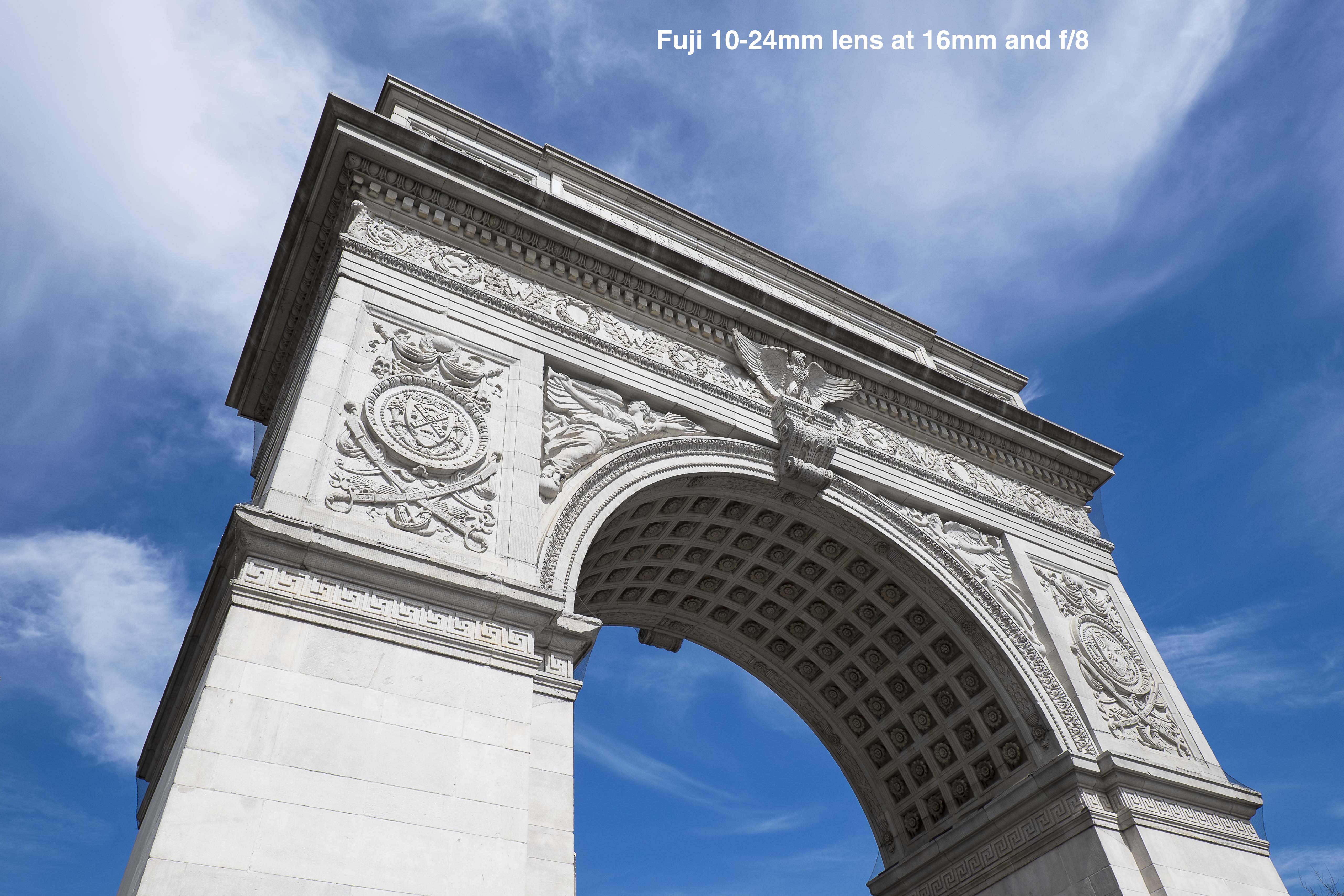
Photographed at an ideal aperture of f/8 and 16mm focal length, it really doesn't get much better than this. Click here to download the high res file.
Other side of the Washington Square monument into the sun at 16mm and f/8.
A new art installation listing the names of 392,486 artists is located along the Hudson River. It is part of the Whitney 2014 Bienal, and titled "Artists Monument" by Tony Tasset. 
10mm at f/16. Things don't get any sharper than this. 


Conclusion:

I went into this test expecting many of the typical disappointments associated with super-wide angle zoom lenses -- corner softness, rectilinear distortion, heavy vignetting. Instead I came away with even more respect for the folks at Fujifilm for making such an excellent lens with virtually none of the aberrations that usually plague this breed of zoom. This truly is one of the best super-wide angle zooms I have even used, and well worth its modest price of $999.99.

An aperture of f/4 may not be ideal, but with the added feature of image stabilization allowing you to hand hold it at one shutter speed lower than usual, you pretty much regain the stop anyway. Plus for the type of work a lens like this will usually do it will be often on a tripod and stopped down.

When compared to the Fuji 14mm fixed focal length lens, the 10-24mm seems quite large. It did not seem to feel that way, however, even though I was using it on the smaller X-E2 camera. The package of camera and lens was quite comfortably balanced.

I am not sure I would own both the 10-24mm zoom and the 14mm lens. One or the other should be sufficient to cover the range. Nonetheless, it is nice to have the choice as the Fuji lens lineup continues to expand, and it is also nice to be able to make the choice based on size, price, and comfort rather than upon quality. Both lenses are equally superb, and literally best of breed at what they deliver.

With the X-E2 in 16:9 crop mode, this photo of the Flatiron Building was taken at 19mm and an exposure of 4.5 seconds in order to create the blurred lights of passing traffic.

If you are planning on purchasing this lens, you can help support this site at no extra cost to you by purchasing from one of our affiliate sellers listed below -- and thanks for your support.

The Fujifilm XF 10-24mm f/4 Lens can be ordered from :   Amazon
The Fujifilm XF 14mm f/2.8 Lens can be ordered from :   Amazon


Other Items on amazon :


Saturday

New Fujifilm XF 50-140mm F2.8 R LM OIS WR Lens

Fujifilm XF 50-140mm F2.8 R LM OIS WR Lens
Fujifilm has announced its second weather-resistant X-series zoom lens, the Fujinon XF 50-140mm F2.8 R LM OIS WR. Designed to accompany the water- and dust-resistant Fujifilm X-T1, the lens offers an equivalent 76-213mm range on Fuji's X-series interchangeable lens cameras - essentially equivalent to a popular 70-200mm telephoto zoom on full frame.

Built with 23 elements in 16 groups, the 50-140mm uses an internal zoom design so that the lens maintains the same overall length as it zooms. The lens features two OIS elements in conjunction with a high-performance gyro sensor and unique stabilization algorithm, inspiring Fujifilm reps to make some pretty confident claims about IS performance of something in the realm of 5 stops by CIPA standards when we last saw them. Additionally, autofocus is driven by the 'world's first' triple linear motor for faster autofocus and quieter operation.

It features the latest technology, including dust / water and low temperature resistance, a triple linear motor, and the world's top image stabilization technology in its class, so that users do not miss a shot in any conditions. Its advanced performance makes it a perfect choice, not only for portraiture and snapshots, but also to capture fast-moving subjects in sports or wildlife photography, and for general outdoor nature photography.

FUJINON XF50-140mmF2.8 (76-213mm) R LM OIS WR key features:
  • FUJIFILM X-Mount is compatible with all FUJIFILM interchangeable system cameras
  • Weather-resistant design with more than 20 sealing points
  • Triple Linear Motor for high-speed, quiet AF and nearly silent operation
  • Comprised of 23 glass elements in 16 groups with five ED lens elements and one Super ED lens
  • Seven rounded aperture blades for smooth, circular bokeh
  • Uses new Nano-GI (Gradient Index) coating technology, that alters the refractive index between glass and air to reduce ghosting and flare
  • Powerful optical image stabilization minimizes shake and blur in low light

See all the Newest Products in Camera, Photo & Video Announced at Photokina, the World's Leading Imaging Fair: Photokina at amazon.com

Monday

Fujifilm X100T Digital Camera Review

Fujifilm X100T
Fujifilm refined the formula and performance with the X100S almost 2 years ago, and now the company's back with the X100T.


The Fujifilm X100T shares the same 16.3MP X-Trans CMOS II image sensor, the same EXR Processor II image processor, and the same bright 35mm-equivalent f/2.0 prime lens that together makes this a great little candid street shooter.


Key Features:

  • 16MP X-Trans CMOS II sensor (with on-sensor phase detection elements)
  • 35mm equivalent f/2 lens
  • Hybrid EVF with 2.3m dot LCD and more advanced overlays in optical mode
  • 3.0" 1.04m dot rear LCD (720 x 480 pixels)
  • Macro shooting down to 10cm (3.9")
  • Built-in Wi-Fi with remote control function
  • Rear command dial
  • Seven customizable buttons
  • Customizable Q menu
  • Built-in ND filter
  • Optional electronic shutter mode (increasing maximum shutter speed to 1/32000 sec)
  • 'Classic Chrome' film simulation mode
  • 1080p movies at 60, 50, 30, 25 and 24fps
  • Exposure control for movies
  • Built-in intervalometer
  • Stereo mic input (2.5mm-type)
So what has changed?

Some of the biggest new features can be found in the viewfinder. This focus aid is available when using the optical viewfinder on the X100T; the focus patch shows up in the bottom corner of the viewfinder, so you can effectively focus manually when using the optical finder.

The optics of the viewfinder have been adjusted so that it provides coverage of 92% of the final image, when used in optical mode. This figure refers to the framing offered by the 'brightlines' shown in the finder - they're less than 100% because the actual field-of-view changes, based on focus distance: the 92% coverage is a compromise between the field-of-view and closest focus and at infinity.

The EVF LCD is now a 2.3-million dot panel that offers 100% coverage of the scene. The screen on the back of the camera has gotten a refresh, too, jumping to 3-inches from 2.8-inches, and (more importantly) jumping more than 50% in resolution up to 1.04-million dots.

There are a few external changes, as well. The top and bottom plates are now magnesium, and ridges have been added to the shutter speed dial, aperture ring, and exposure compensation dial. The exposure compensation dial now extends to +/-3 EV, an improvement from the +/-2 EV supported by the X100S, and the camera's command lever has been replaced by a 4-way controller.

The Fujifilm X100T also adds a fully electronic shutter mode. The brand new electronic shutter delivers ultra-high-speed exposures up to 1/32000sec. Shallow depth-of-field effects can now be shot with the aperture wide open even in snow or on the beach under clear skies. As there are no mechanically operated parts, there is no shutter sound so natural expressions of animals and sleeping babies can be captured more easily than ever before.

The camera's aperture ring has been modified, so that it can now be controlled in 1/3 f-stops, rather than the whole stops that the existing models offered. The exposure compensation dial has also been amended so that it now extends to +/- 3EV - something existing users had been calling out for. The other big change, in terms of exposure control is that the X100T retains the ability to apply exposure compensation when using Auto ISO in manual exposure mode, meaning that you can choose shutter speed, aperture and image brightness and let the camera do the work.

Fujifilm has also gifted the X100T with in-camera Wi-Fi connectivity -- Built-in Wi-Fi means users no longer have to rely on wireless SD cards for sharing images, and remote shooting is possible with the Fujifilm Camera Remote app for iOS and Android devices.

The Fujifilm X100T can also pair up with an Instax SHARE Smartphone Printer for a quick and easy printout.

The Fujifilm X100T also features the Classic Chrome film simulation mode that first appeared last month on the X30 compact camera.

The camera, which uses die-cast magnesium alloy for the top and bottom of the body, measures 126.5 x 74.4 x 52.4 mm (5 x 2.9 x 2.1 in) and weighs 440 g (15.5 oz).


Friday

Fujifilm X30: The Joy of Shooting in Back..!

Fujifilm X30
The Fujifilm has updated its X20 compact camera with the introduction of the Fujifilm X30, it has the same 12Mp 2/3-inch X-Trans CMOS II sensor, processing engine and 4x zoom lens as before, so image quality is expected to be the same.

While not a huge leap forward, Fujifilm's X30 has some noticeable changes, including a move from an optical to electronic viewfinder (EVF) with a blistering 0.005-second lag in place of the last model's optical version. This is the same EVF as is found in the popular Fuji X-T1 and it has 2.36 million dots and 0.62x magnification.

Additionally, the X30′s 920,000-dot 3-inch tilting LCD is larger and sports twice the resolution of the X20′s fixed screen. Alternatively, images can be framed on the screen of a smartphone connected by the X30's Wi-Fi system and Fuji's app.

Fujifilm has also improved the battery life in their latest compact camera that will be available in both black and silver finishes. Fujifilm explains a little more technology included in its Real Time Viewfinder:

“With a magnification of 0.65x and a display lag time of just 0.005sec, the X30 has the largest and fastest viewfinder in its class. It offers a clear, high-definition Live View thanks to the new 2.36M-dot organic EL electronic viewfinder and newly-designed dedicated lens, plus visibility has been improved by automatically controlling finder brightness according to the ambient light levels.

The Live View display can also be set the ‘Preview Pic. Effect’ function to reflect shooting conditions or offer a natural view close to what is seen with the naked eye, while the viewfinder’s eye sensor will also automatically switch the visible information when the camera is positioned vertically; something that was not possible with the previous model’s optical viewfinder.”

It has a 12-megapixel 2/3-inch X-TRANS CMOS 2 sensor, with some of the fastest autofocus in the world, plus the same 28-112mm (35mm equivalent, 4x magnification) f/2.0-2.8 lens. It will remain a handy, fun camera for street photography.

As before the lens has an effective focal length range of 28-114mm and a maximum aperture of f/2.0. This has a dual ring arrangement, one for zooming and the other being customisable and able to adjust aperture, sensitivity, white balance, Film Simulation mode or drive mode.

The Fujifilm X30 will be released on September 30, 2014.

Fujifilm X30 key features

  • 12MP 2/3"-type X-Trans CMOS II sensor (8.8 x 6.6mm)
  • EXR Processor II
  • 28-112mm equiv. F2.0-2.8 lens with manual zoom adjustment
  • Hybrid (contrast + phase detection) autofocus system
  • ISO 100-3200, expandable to 12800 (JPEG only)
  • Six customizable buttons plus ring around lens
  • 2.36M dot OLED electronic viewfinder with 0.65x (equiv.) magnification
  • 3.0" 920k dot 3:2 tilting LCD
  • 12 fps continuous shooting
  • Addition of 'Classic Chrome' Film Simulation Mode
  • Built-in Wi-Fi including remote control from a smartphone or tablet
  • Full HD movie recording (1080/60p, 36Mbps bit rate), with built-in stereo microphone and external mic input
Latest price from amazon.com:

Monday

Fujifilm X-T1 16 MP Compact System Camera Review

Fujifilm X-T1 16 MP Compact System Camera
The Fujifilm X-T1 is a premium interchangeable lens camera.

The Fujifilm X-T1 features evolved SLR-style handling, mechanical dials and weather-resistanceMulti Mode Viewfinder (when paired with a weather resistant X mount lens), together with all the benefits of an X-Series camera, such as compact size, excellent mobility and high-speed performance.

What's more, its newly developed electronic viewfinder is almost indistinguishable from an optical viewfinder thanks to its ultra fast display speed.

Before we get into much more detail, and if you're not familiar with the XT-1, here are the technical highlights:
  • 16MP X-Trans CMOS II sensor
  • APS-C sensor (1.5 crop factor)
  • Weather-resistant body
  • ISO 200-6400, plus 100 - 25600
  • A huge 2.36M dot OLED electronic viewfinder with 0.77x (equiv.) magnification
  • 'Dual view' in EVF, which shows the standard view plus an enlarged focus peaking/digital split image
  • Top-plate controls for ISO, shutter speed, exposure compensation, drive mode and metering
  • Six programmable function buttons
  • 3.0" 1.04M dot 3:2 tilting LCD
  • 8 fps continuous shooting with continuous AF (for a burst of around 20 frames)
  • Built-in Wi-Fi including remote control from a smartphone or tablet
  • HD movie recording (1080/60p, 36Mbps bitrate) and built-in stereo microphone
  • Clip-on external flash (Guide Number 11)
  • Optional battery grip or hand grip
Just fantastic. If you're looking at this camera then you've probably already done tons of research, so I'll just leave bullet points.

The XT-1 is about as perfect as a camera (for my purposes) as i have ever found, it certainly sets a new bench mark.

Pros -

  • It's TINY. I was expecting it to be bigger, but it's barely bigger than the X-E1/X-E2.
  • Fits in the hand beautifully. Fuji have put a rubber "nub" on the rear top right corner, and it's perfect for one-handed shooting.
  • The knobs on top are great, everything is intuitive. I actually bought the Nikon Df in December and returned it after a couple of weeks, it never became intuitive. The only thing I would change is not having to press the button in when changing ISO every time.
  • Rear screen is big and bright. Seen many comments saying it should be a touchscreen (it shouldn't) and it should flip sideways (it shouldn't) - touchscreens should stay far, far away from cameras!
  • Build quality is ace. Feels rock solid, but weighs practically nothing.
  • SD card slot is on the side, helps with not having to take off tripod to change card.
  • THE EVF! this is incredible. I think the XT-1's EVF is probably the first one that really starts to threaten the OVF.
Cons -

  • the buttons are just a tiny bit TOO indented on the rear of the camera. I'm sure there's a reason for this - weather-proofing maybe, or maybe during testing having looser buttons resulted in too high an occurrence of accidental button pushes, I don't know - but they're a little too indented for me.
  • battery life, but if they'd have used a bigger battery they'd have had a bigger camera.
  • no 2nd memory card slot, but same as above - would have resulted in a bigger camera.

That's it. I absolutely love it. Let others deal with issues such as image quality, frame rate, and the rest. For me the quality is, simply put, quite sufficient. Fuji is doing incredible things - if they can add to their speedlight options they're going to have the perfect setup.

Latest price from amazon.com:

Thursday

Fujifilm XF 18-135mm F3.5-5.6 OIS WR Zoom Lens Review

Fujifilm XF 18-135mm F3.5-5.6 OIS WR Zoom Lens
This latest addition to the company's line up of profession-grade lenses for X-series interchangeable-lens cameras covers a wide shooting range of 27mm wide-angle to 206mm telephoto equivalent.

It has the world's most advanced 5.0-stop image stabilization technology and features a dust-proof and waterproof structure with weather resistant sealing applied to more than 20 different areas of the lens.

This lens comes packaged with the following accessories:

  • Front & Rear Lens Caps
  • Lens Hood

Get Fujifilm XF 18-135mm F3.5-5.6 OIS WR Zoom Lens at Amazon.com

Essentially it handles like a dream. Focusing is Fujifilm XF 18-135mm F3.5-5.6 OIS WR Zoom Lens virtually instantaneous and the images are great.

The FOCAL RANGE is quite broad, and certainly useful. Sure, it could be wider and longer, but it’s still a decent wide-angle (27mm) and a decent telephoto (206mm). I’d personally prefer more degrees at the wide end at the expense of the long though (as the 16-55 will be). A 16-120mm (24-180) with at least a constant f/4 would be more in line with my wishes.

Yeah, it is kinda SLOW. And I am known for using and loving fast primes (25 years as a photojournalist), so when I first saw the specs on this, I was not even interested. As I shoot a D4 on my day-job, my X-T1 is more of my personal (fun/art) camera. But it is highly capable for pro work, and for some things, I’d prefer it.

The useful max f/stops break down like this (or there-abouts) :
  • 18mm 3.5
  • 20mm 3.6
  • 23mm 4.0
  • 28mm 4.2
  • 35mm 4.3
  • 55mm 5.0
  • 70mm 5.3
  • 85mm 5.3
  • 100mm 5.6
  • 135mm 5.6
What the lens lacks in aperture speed, the vibration reduction system (OIS) makes up for. And the OIS in this lens is really amazing, I really think the most useful. Better than Nikkor 70-200 f/2.8. This lens is also highly useful for basic video work (home movies) with the broad focal range and very effective vibration reduction.

The SHARPNESS is actually quite good for this 7.5X focal range. Bit soft in corners wide-open, especially at 18mm (I’d almost wish it was less sharp in corners at the long end vs the wide end) but it is still very useful. In fact, it seems resolving enough at EVERY focal length, which is really pretty impressive. Don’t expect it to match your primes, but I haven’t met any lens that does. There are just too many variables to engineer into making this broad a focal range perfect. I’d certainly say it’s the sharpest all-in-one lens I’ve had though. The multiple ED/Aspherical elements probably help out there.

CONTRAST is very good all the way through, which adds to the impression of sharpness. Flare seems well controlled and Starbursts look decent too.

It’s fairly smooth and creamy for the slow aperture openings it has. Guess the aperture openings stay fairly circular throughout the range and help with OOF highlights for a fairly decent bokeh for a slow lens.

The minimum focus distance (MFD) is another highlight. It makes this lens way more useful as an all-in-one when you are able to get in close on a flower and just about fill the frame. No, its certainly not a 1:1 macro, but its more useful than most primes with generally more-limited MFD. In real-world shooting it seems to be around 10” in front of front element (filter to subject). This 10 inches or so is comparable across the focal range as well, so you can shoot around the same distances from wide angle (27mm) to telephoto (206mm). This is very useful and the close-focusing is helpful for bokeh in macro-ish shots.

One of the major selling points is the WATER RESISTANCE, and that was certainly of interest to me. It’s nice to not have to worry about ruining your lens/camera when you get caught in a shower or want to take a hike and still get nice nature shots in any condition (which is sometimes more productive in cloudy light in drizzle).

It is fairly LIGHT in weight too, making it even better for travel. Although light, the BUILD QUALITY still seems high. The ZOOM ring is very smooth mechanically, and it does not creep around either. I’d prefer a zoom that was totally internal, but probably hard to do with this wide a focal range. My copy seems to be a little tight at just the last few millimeters of zoom, say 128-135mm—but that may loosen with use.

The included hood somehow seems a just bit small for the lens girth to me, and the plastic is slightly a lighter shade (grey vs deeper black of lens) which appears a bit mis-matched to me, but not a big deal. Unfortunately, the hood does not have a great “click” stop once in place either, making it a bit loose and prone to falling off.

The AUTOFOCUS is internal, so you can easily use SFX filters (esp. polarizers) easily. The AF system is FAST and hits the mark well! I’d say its better than my 56mm honestly, with less hunting. It is also extremely QUIET and SMOOTH. Very pleased with the focus.

In conclusion, This is a very USEFUL lens, even though it is slow. If it were faster with an even broader focal range, it would also be very heavy, very large, with a huge front element (that needed 77mm or larger filters). As such, it suits the small mirrorless bodies (such as the X-T1) perfectly as a take-anywhere but highly-capable camera system.
Fujifilm XF 18-135mm F3.5-5.6 OIS WR Zoom Lens
  • f=18-135mm (35mm format equivalent: 27-206mm)
  • Weather Resistant
  • 5.0 Stop Image Stabilization

Saturday

Making the most of a distracting zoo environment with a Fuji 55-200mm zoom and the X-T1

One afternoon in Florida we took a break and visited a local wildlife preserve hoping to get in some fun photography of the animals. Problem was all the animals were in cages with very narrow openings in their wire fencing, and in most cases the backgrounds were inappropriate and distracting. To get around this problem I put my longest lens, the 55-200mm zoom, on the Fuji X-T1. Zooming the lens to its longest focal length helped minimize the obstruction from wire cages.  I also set the lens to its most open aperture, and positioned it as close as possible to the wire cages. This gave me the lowest depth of field and threw the wire cages mostly out of focus.

This Florida Panther was my most difficult image to deal with because the wire fencing was right over his face. 
You can see the original photos below. The most distracting  fencing was in the Florida Panther shot because he was so close to it.

These are the original photos of some of the animals with their distracting elements. I limited myself to head shots to keep the lens at its longest focal length and minimize the focus on the foreground wire fencing. The focus point was placed on the eye of each animal. 
I found some tropical palm leaves growing nearby and photographed them totally out of focus to substitute as backgrounds later in Photoshop.
Caracara
For all the bird portraits I created a selection mask around the head to eliminate the background and substitute one of my out-of-focus palm leaf photos instead. Later I put a vignette around the images to concentrate the attention around the birds face. 

Canebrake Rattlesnake photographed through a Plexiglas window. For this one I had to deal with some odd lighting.
Green Heron
Green-winged Macaw
If you are planning on purchasing this camera or lens, you can help support this site at no extra cost to you by purchasing from one of our affiliate sellers listed below and thanks for your support :

- The Fujifilm X-T1 camera body only is available at :  Amazon
- The Fujifilm 55-200mm zoom lens is available at :  Amazon

Lifestyle shoot with the Fuji X-T1 - a debriefing review

I call this a "Debriefing review" to differentiate it from my regular "hands on" reviews, which are based on normal use tests I do for about a week with a new piece of camera equipment. For this debriefing review I put the camera, in this case a Fuji X-T1, through a specific shooting event to gauge its handling characteristics under fire. Since it came out, I have suspected that the X-T1 might be the first mirrorless camera capable of dealing with the demands of a fast paced lifestyle shoot, and I set out to see if my suspicion was true.

I was in Florida where we arranged to have two models meet us on a beach just after sunrise for a three hour shoot. The watch-word for the shoot was "energy". We wanted the models to me very active and bursting with enthusiasm. This meant keeping both the models and I me in constant motion, and necessitated a camera capable of executing very fast, continuous focus adjustments at mostly open apertures. To put even more technical stress on the situation, I decided to shoot using very intense back lighting with no fill whatsoever, save for what was provided naturally by the sandy beach. I wanted a very light and airy, blasted out look to the scene. I needed a camera that could handle such an extensive dynamic range.


Typically, in a shoot like this I would use a Nikon D4 and f/2.8 zooms. We did have a D4 outfit with us just in case things went wrong with the X-T1. I can tell you up front that I never once felt a need to switch over to the Nikon system. I did the entire shoot with the Fuji X-T1, ending up with over 2100 RAW images for later editing.

I used four Fuji lenses:  The 18-55mm was my main working lens, followed by the 55-200mm zoom. For portraits I switched to the 56mm f/1.2, and in one situation needed the 14mm. 


Auto-focus was my biggest worry going into the shoot, but the X-T1 held its own, returning an extremely high ratio of focused images despite the back light, and despite the 8fps continuous shooting speed.  My first SD card was a new high-speed Sandisk UHS-II, and it made a difference. I could tell immediately after I filled the 32GB card and had to switch to a slower UHS-I.  No question I will be picking up some more of the faster cards.

Color balance with the X-T1 was right on, although it might not be readily apparent from looking at the shots. I was using early morning light and pushing it to the warmer side in post-processing. 

The models repeated this running scene coming towards me about a half dozen time to insure I had focus. I needn't have worried. The X-T1 returned as many in focus shots as I would expect from the D4, which I consider to be the king of auto-focus.
I had many scenes where the action was changing rapidly and I had to keep the camera shooting at a fast clip to capture a spontaneous moment. I doubt this would be possible with any other EVF (electronic view finder). Their refresh rates have been just too slow. The EVF in the X-T1 is a world apart from any other out there, and fully capable of keeping up with the action. Without this EVF I doubt that a lifestyle shoot like this would even have been possible.

One thing I really grew to love was the tilting screen. This feature made it so much easier to get the camera really low to the sand for shots like the the two below.  I get really nervous working on sand with cameras. It takes so little sand to ruin a lens or camera so I try never to touch the sand myself because I don't want to get any on my hands to transfer to the equipment. With the tilt screen I was able to hold the camera low while still maintaining a good distance above the sand.

One of the few beach scenes I did with a front light, but still no reflector fill.  Just let the camera's natural dynamic range cover the full exposure. 


For the shot below done after the beach shoot, I had the 14mm lens on the camera and held it high above the models while composing and shooting with the tilt screen. 


A feature I enjoyed in post-processing with the new RAW release candidate for Adobe Bridge, was having the Fujifilm film profiles available. I found it convenient switching an image to one of the profiles -- Provia, Velvia, or Astia -- and tweaking the colors and contrast from there. Saved me a lot of time. 


Really nice background bokeh was achieved by using the 56mm lens at a wide open aperture for all the portrait shots.

Almost all the scenes had a blasted out background and highlights, but that was the look I wanted. It takes a really good, modern digital camera to deliver a wide enough dynamic range to shoot like this without loosing too much detail. The X-T1 delivered.

Everything was shot in manual exposure mode at ISO 200. There were quite a few times I found myself wishing Fuji had given its X cameras a base ISO of 100 instead. Sure would have made it a lot easier shooting with open apertures on a bright day like this.

I used the VG-XT1 vertical battery grip on the camera to provide extra power and better handling. I have to say, this accessory is a real winner. It makes the camera so much more comfortable to handle in a fast moving situation.

A real surprise was how long the battery lasted. According to the Fuji specs, we should expect around 350 shots per charge. I shot over 2100 RAW images throughout the day and only used up part of the one battery that was in the accessory battery grip. Seems unusually frugal to me, but I'm not going to complain. Some day I am going to have to find out just how long I can make two batteries last.


For close-up portraits I switched to the 56mm f/1.2 lens. I wanted to use it wide open, or not more than f/2, so I needed to put a 3-stop neutral density filter on the lens to cut down the exposure. 

This close-up was taken with the 56mm at f/1.8.
My one major beef with the X-T1 was with the focus buttons. They are just too small, making them hard to hit without looking. I found myself constantly having to take my eye away from the viewfinder to look at the focus wheel directly in order to find the buttons. This is something Fuji is going to have to address in a future version of this camera. Perhaps over time I will get used to them as they are. Perhaps my thumbs are just too big for such a tiny camera. In the meantime, it is annoying and really slows me down. One possible solution I am trying is to add the AF-Focus Area function to the Fn1 button on the front of the camera because it is easier to find and press.

Another portrait done with the 56mm lens set to  f/1.6. The model's eyes are tack sharp. 

I mentioned in my initial review of the X-T1 that I thought it might be the first mirrorless camera to truly move to a usable level on a par with a pro-DSLR, and I was curious to try it as my only camera during a lifestyle shoot. It was a real pleasure to work with such a small outfit. I was able to work entirely out of my photography vest for the entire shoot. 

The real test of the day's experience is whether or not I will choose to shoot with the X-T1 outfit again. I can answer that with a resounding "Yes".  The camera and lenses were spot on, with the results as good as any camera system I have used for this type of shooting. The convenience of such a portable system delivering such excellent results is just too enticing to give up. Plus, the new fast aperture zooms Fuji has coming down the pike are only going to make this system even better.

This summer I will be giving a workshop on Shooting Lifestyle with Available Light at the Charleston Photography Workshops. 

If you are planning on purchasing this camera, you can help support this site at no extra cost to you by purchasing from one of our affiliate sellers listed below and thanks for your support :

- The Fujifilm X-T1 camera body only is available at:  Amazon
- The Fujifilm X-T1 with 18-55mm lens is available at:  Amazon

Homage to Malevich and the Suprematists with the Fuji X-T1

In 1918 the avant garde Russian artist and founder of the Suprematist art movement, Kasimir Malevich, painted his purely abstract compostion, "White on White" a skewed white square painted onto a square canvas also painted white. As manifestations of the Suprematist art manifesto with its basis in pure artistic feeling, this painting, along with "Black Square" painted in 1915 revolutionized the art world and finalized its departure from a reliance on real-world subjects, introducing instead completely non-objective, abstract geometric compositions. They seem tame by today's standards, but were quite shocking for their time.

Kasimir Malevich Suprematist compositions, "White on White", 1918, and "Black Square", 1915.
Every now and then I give myself a photographic exercise based on a theme. This weekend I decided to pay homage to Malevich by limiting my palette to purely abstract compositions in black and white. While Malevich used paint, photographers use light and shadow to create fluctuations in tones.

I set my Fujifilm X-T1 camera to square format and black & white and used two lenses, the 60mm macro and the 56mm f/1.2 with a Nikon 6T close-up lens on it. In both cases I set the camera to manual focus because I was shooting wide open and wanted to place the focus point in very specific locations. I usually shoot the Fuji  X cameras in RAW plus jpg. Most of these images were from the original jpg compositions with a bit of post-processing added contrast.

Folded papers and shadows
Folded newspapers
Paper corner
Chair in morning light
Folded sheet of paper near a window
Shadow reflection of leaves on a window sill
Vent with shadow
Open book, study 1
Open book, study 2
Two sheets of paper with shadow
The white blouse
Tulips with window frame
Discarded white towel on the sidewalk
Diagonal street stripes and tar
Empty store window sign - probably my most Malevich-like composition
The look - my least Malevich-like compostion, but I couldn't resist the eyes

Popular Posts

Blog Archive

Labels

100mm canon lens 12mm Lens 16-35mm Lens 16-35mm Vario-Tessar T FE F4 ZA OSS E-Mount Lens 18-135mm Lens 18-55mm Lens 20mm Lens 22mm Lens 28-70mm Lens 50mm 50mm f/1.4G SIC SW Prime AF-S 50mm Lens 645D 645Z A7S About Digital Zoom About Optical Zoom About Shutter Speed accessories Accessories Acer Acer Aspire Action Cam Action Cam Mini AF-S NIKKOR 20mm f/1.8G ED AF-S NIKKOR 20mm f/1.8G ED Lens Alpha 77 II Alpha 7S Alpha A7S Android Aperture Apple Art of Digital Wedding Photography Asus ASUS ROG Beachville Museum best camera best camera 2014 best camera for beginner best camera lenses best canon camera lens best compact camera system best compact cameras best dslr best dslr camera best dslr camera 2014 best dslr camera for beginners 2014 best entry level dslr 2014 best nikon camera best selling cameras of 2014 Best Shutter Speed Best Wedding Photography BlackBerry Blurring Object Buy Digital Camera Tips Buying Digital Camera Tips camera Camera Aperture Canon canon 100mm lens canon 100mm lens review canon 100mm macro Canon 700D Canon 70D Canon 70D Focus Issues Canon Camera Canon EF 16-35mm f/4L IS USM Lens Canon EF 24-105mm f/3.5-5.6 IS STM Canon EF 400mm f/4 DO IS II USM Lens Canon EF 50mm f/1.4 USM Canon EF-M 22mm f2 STM Canon EF-S 18-55mm f/3.5-5.6 IS II Lens Canon EF-S 18-55mm f/3.5-5.6 IS STM Lens Canon EF-S 24mm f/2.8 IS STM Lens Canon EF-S 55-250mm f/4.0-5.6 IS STM Lens canon eos Canon EOS 700D Canon EOS 7D Mark II Canon EOS Rebel Canon EOS Rebel T5 Canon EOS Rebel T5i Canon Lens Canon SX50 Canon T3i 600D Canon T5i Capture Motion CF cheap cameras cheap slr cameras Choosing aDdigital Camera Choosing the Best Shutter Speed Chromebook compact cameras Compact Flash Memory Cards Contour Contour Action Cam Contour Action Camera Contour Camcorder Contour ROAM3 COOLPIX Coolpix P600 D750 D810 Deals Dell Difference between Optical Zoom and Digital Zoom Digital Camera Digital Enhancement Digital Photography Lighting Digital Photography Success Digital Wedding Photography Digital Zoom Versus Optical Zoom discount cameras DLSR DMC-GM5 DMC-LX100 DSC-RX100M III Dslr dslr camera Dual-SIM DX E-PL7 eBook EF-M 22mm f2 STM EF-S 18-55mm F3.5-5.6 IS STM Lens EOS 700D EOS Rebel T5i FE 16-35mm F4 ZA OSS Lens Finding The Right ISO Setting Flashpoint Flashpoint Blast Pack Flashpoint Lighting Flashpoint SL-180K1 Flashpoint Streaklight Flashpoint Streaklight 180 Focus Mode Focus Modes in Digital Cameras Fuji Finepix S1 Fuji S1 Fuji X Fuji X-E1 Fuji X-E2 Fuji X-Pro1 Fuji X-T1 Fujifilm Fujifilm Camera Fujifilm Lens Fujifilm X-T1 Fujifilm X100T Fujifilm XF 18-135mm F3.5-5.6 OIS WR Zoom Lens Fujifilm XF 50-140mm F2.8 R LM OIS WR Lens Fujinon XF 50-140mm F2.8 R LM OIS WR Fujujifilm Full Frame FX FZ1000 Galaxy Galaxy S Duos Gaming Laptop Garden Photography Garden Photography Tips GM5 good cameras gopro 3 black edition gopro hero 3 black edition gopro hero 3 update gopro hero 3+ HC-X1000 HDR-AZ1 How to Set White Balance How to Take Better Photographs Hp HP HTC Inspiron ISO Setting ISO Setting Tips Keurig laptop latest canon dslr 2014 Learn About Camera Aperture Leica Lenovo Lens Lens Camera LG Lighting lowepro camera bag Lumix Lumix DMC-FZ1000 LUMIX DMC-GH4 Lumix DMC-GM5 Lumix DMC-LX100 LUMIX GH4 Lumix LX100 LX100 M. Zuiko Digital ED 12mm f/2.0 Lens M4/3 Macro Photography Masking Masking in Photoshop Masking Technique MILC Mini Mini POV HD Video Camera Mirrorless Motorola new canon 2014 Niagara Falls Nikon Nikon 24-85mm f3.5-4.5G ED VR Nikon 50mm f/1.4G SIC SW Prime AF-S Nikon 50mm f/1.4G SIC SW Prime AF-S Nikkor Lens Nikon 50mm f/1.8D AF Nikon 50mm f/1.8D AF Nikkor Lens Nikon 50mm f1.8G AF-S Nikon AF-S NIKKOR 20mm f/1.8G ED Lens nikon camera Nikon Camera nikon camera review Nikon Coolpix P600 Nikon D3s Nikon D4s nikon d5200 nikon d5200 review nikon d5200 vs canon 7d Nikon D610 nikon d7100 nikon d7100 review nikon d7100 reviews nikon d7100 vs canon 7d Nikon D750 Nikon D810 Nikon Flashes Nikon Lens nikon professional camera nikon professional cameras Nikon SB-500 AF Speedlight Nokia NX 50-150mm f/2.8 with OIS NX1 Off Camera Flash Off-Camera Speedlites Olympus Olympus 12mm f/2.0 Lens Olympus Camera Olympus E-PL7 Olympus Lens Olympus M Zuiko Digital ED 12mm F2 Olympus M. Zuiko Olympus M. Zuiko Digital ED 12mm f/2.0 Lens Olympus Om-D Olympus OM-D E-M1 Olympus OM-D E-M10 Olympus OM-D E-M5 Olympus PEN E-PL7 OM-D E-M1 OM-D E-M10 OM-D E-M5 Oppo Panasonic Panasonic Camcorder Panasonic Camera Panasonic DMC-GM5 Panasonic FZ1000 Panasonic GX7 Panasonic HC-X1000 Panasonic Lumix DMC-FZ1000 Panasonic LUMIX DMC-GH4 Panasonic Lumix DMC-GM5 Pavilion PEN E-PL7 Pentax Pentax 645D Pentax 645Z Pentax Camera Pentax K-3 Perfect Lighting Photography Ebooks Photography in The Garden Photoshop point and shoot Power Packs Power Shoot powershot Product Photography quality nikon camera QX Lens Style Camera QX1 QX30 Red-eye Effect Red-eye Reduction Feature Reviews ROAM3 RX-100 RX100M III S1 Samsung Samsung Camera Samsung NX1 SB-500 AF Speedlight SD SD Memory Cards Select Digital Camera Sheraton on the Falls Shooting a Night Landscape Shooting a Night Landscape Tips Shooting Landscapes During The Night Shutter Speed Shutter Speed Tips Sigma SL-180K1 Smartphone Smartphone Photo Smartphone Photography Smartphones Softbox Sony Sony 16-35mm Vario-Tessar T FE F4 ZA OSS E-Mount Lens Sony A5100 Sony Action Cam Sony Action Camera Sony Alpha 5100 Sony Alpha 77 II Sony Alpha A7S Sony Camcorder Sony Camera Sony DSC-RX100M III Sony HDR-AZ1 Sony Lens Sony QX1 Sony QX30 Sony RX Sony RX100M III Sony SEL2870 FE 28-70mm f/3.5-5.6 OSS Lens Sony Ultrabook sony Vaio Sony Xperia Sony α5100 Sony α77II Sony α7S Streaklight Tablet Tamron Tips Touchscreen Transformer Book tripod True Nature of Digital Photography TV Ultrabook Ultrazoom Understanding Masking Understanding Shutter Speed Underwater Digital Camera Vario-Tessar T Waterproof HD Video Camera Wedding Photography Wedding Photography Tips what camera to get as a beginner what is a dslr White Balance Setting Windows Phone wireless flash wireless flash trigger receiver X-E1 X-Pro1 X-T1 X100T XF 50-140mm F2.8 R LM OIS WR Lens α7S